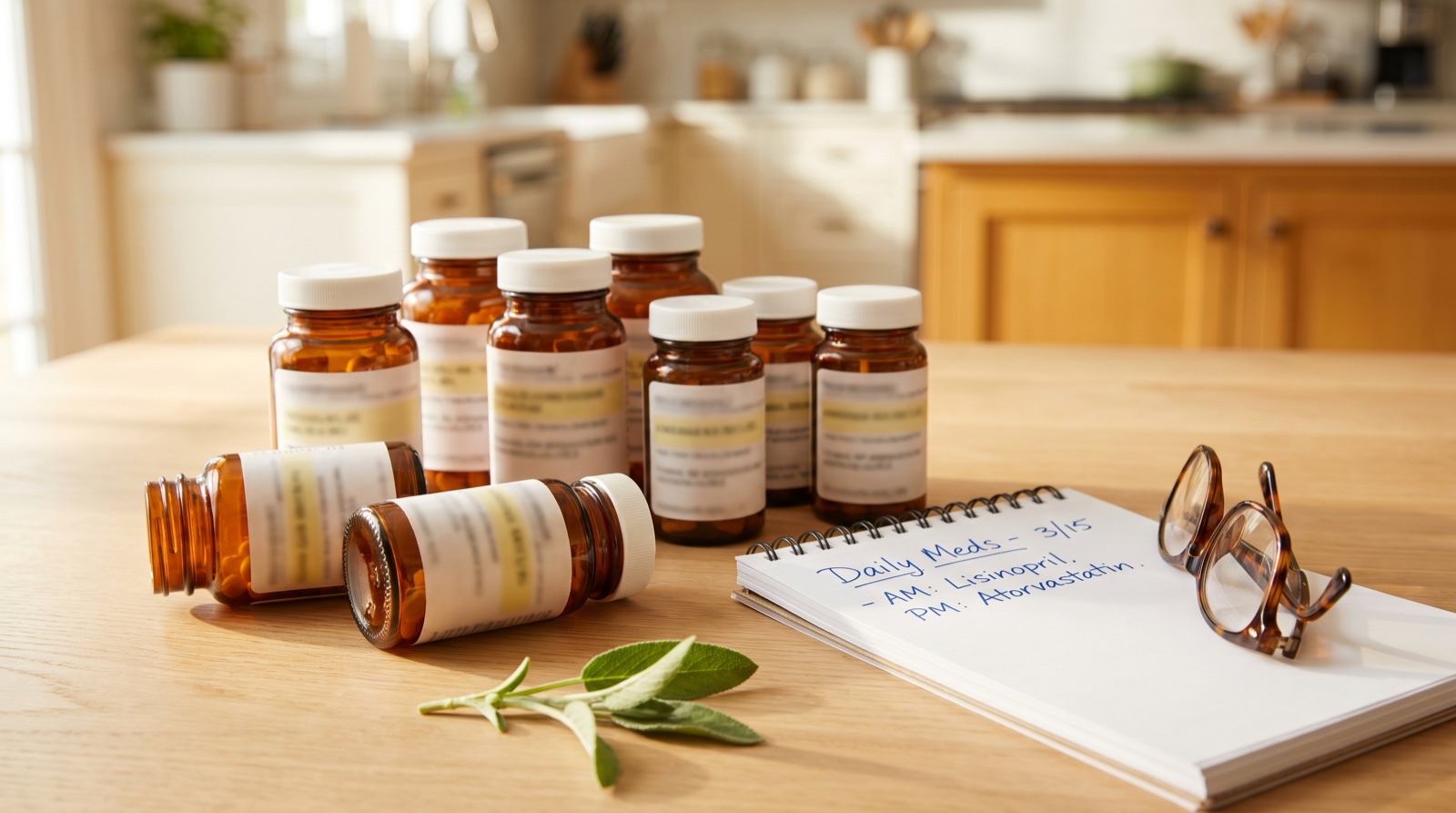
I’ve Never Once Looked Up the Beers List by Name
I need to say something that might surprise you: in over a decade as a hospital pharmacist, I have never once pulled up the Beers Criteria by name to check a patient’s medications.
Not because it’s wrong. Because I don’t need to. When you’ve reviewed thousands of medication lists, you just know what to flag. It’s instinct at this point. I see lorazepam in an 82-year-old and my brain registers the fall risk before I’ve finished reading the next line. I see Tylenol PM and I already know we’re going to have a conversation about the diphenhydramine hiding inside it.
The Beers List states the obvious. It tells pharmacists and doctors things we should already know. And in some cases, it creates unnecessary fear around medications that are perfectly fine for the right patient.
What actually worries me isn’t any single drug on that list. It’s what happens when three, four, five of those drugs are sitting in the same medicine cabinet, prescribed by different doctors who don’t talk to each other. That’s where people get hurt. Not because one pill is “bad” — but because the combination creates risks that nobody is watching for.
That’s what I call the multiplier effect. And it’s the thing the Beers List doesn’t adequately address.
Why the Same Pill Hits Harder After 65
Before I walk through the specific drugs, you should understand why medications that were fine at 50 can become dangerous at 75. It’s not just “older people are more fragile.” The body is working differently at a fundamental level.
The kidneys slow down. Your parent’s kidneys are filtering drugs out of their blood less efficiently every year. By age 75, even without any kidney disease, their filtering capacity may have dropped to half of what it was at 30. That means drugs build up to higher levels than anyone intended. About 40% of drug toxicity cases in elderly patients happen at “normal” prescribed doses. The dose was right for younger kidneys, not theirs.
The liver can’t keep up. Liver volume shrinks by 20-30% between age 30 and 70, and blood flow to the liver drops by about 40%. The enzymes that break down medications become less active. A dose of morphine in a 75-year-old can produce blood levels far higher than the same dose in a 40-year-old, because the liver isn’t clearing it as fast on the first pass.
Body composition shifts. Older adults carry more fat and less water. Fat-soluble drugs (like Valium) get stored in the expanded fat tissue and stick around for days longer than they should. Water-soluble drugs (like digoxin) get concentrated into a smaller pool of body water, hitting higher peak levels from the same dose.
The brain becomes more sensitive. The blood-brain barrier (the membrane that protects the brain from chemicals it shouldn’t be exposed to) gets leakier with age. Drugs that barely touched the brain at 40 can cross right through at 80. On top of that, receptor systems in the brain become more reactive to sedatives, opioids, and anticholinergic drugs. The brain at 80 is just wired differently than it was at 40.
Multiple drugs interact. More than 88% of older Americans take at least one prescription medication monthly, and over 66% take three or more. A patient on 5 or more medications has an 88% increased risk of a harmful drug event compared to someone on fewer. At 20 medications, the chance of a dangerous drug-drug interaction is essentially 100%.
This is the backdrop against which every Beers Criteria drug is prescribed. It’s why the same Advil that a 45-year-old takes without thinking can wreck a 78-year-old’s kidneys.
The Drugs on the Beers List: My Honest Take on Each
Here’s where most articles just recite the list. I’m going to tell you what I actually think about each one after reviewing thousands of medication lists in the hospital. Some of these I agree with completely. Some I think are overblown. And some depend entirely on the patient.
Benadryl and the “PM” Sleep Aids: I Agree, and This One Scares Me
What we’re talking about: Diphenhydramine, the active ingredient in Benadryl, ZzzQuil, Tylenol PM, Advil PM, Unisom SleepGels, and basically every over-the-counter sleep aid on the shelf.
This one I agree with fully. Diphenhydramine is an anticholinergic drug, meaning it blocks a brain chemical called acetylcholine, the same chemical that plays a central role in memory and attention. The aging brain already has less acetylcholine to spare. Research has found that people with the highest long-term exposure to anticholinergic drugs were significantly more likely to develop dementia and Alzheimer’s disease.
Beyond the dementia risk, it causes confusion, dizziness, falls, urinary retention, and fast heart rate. Any of those on their own is concerning. Together, they’re a disaster.
I recently saw a patient who accidentally overdosed on Tylenol PM. They were confused, they didn’t realize how much they’d taken, and they kept taking more. That’s the hidden danger with these OTC products. People don’t think of them as “real” medications. They think, “It’s just Tylenol PM, I’ve taken it for years.” But the diphenhydramine component is a brain-toxic antihistamine, and the Tylenol component stresses the liver. In a confused elderly person, that combination can spiral fast.
The worst part: studies show older adults are twice as likely as younger adults to use diphenhydramine sleep products for 20 or more days per month. It starts as “once in a while” and becomes every night. Most seniors never mention OTC medications to their doctors.
What to use instead: For allergies, cetirizine (Zyrtec) or loratadine (Claritin) are far safer. For sleep, the best evidence supports cognitive behavioral therapy for insomnia, which actually works better than any pill long-term.
Bottom line: If your parent has a bottle of anything with “PM” on the label, or a box of Benadryl in the medicine cabinet, that’s worth a conversation. If the confusion tends to show up in the evening, my article on sundowning and nighttime medication refusal covers how these same PM products can feed into it.
Benzodiazepines: I Agree They’re Risky, But People Need Them
What we’re talking about: Alprazolam (Xanax), lorazepam (Ativan), diazepam (Valium), clonazepam (Klonopin), temazepam (Restoril).
I see lorazepam constantly in the hospital. Patients addicted to benzos. Patients who have been on them for 20 years and nobody ever tried to take them off.
The Beers List says avoid them in older adults, and the data backs that up: benzodiazepine use increases hip fracture risk by 50-80%. About 8.9% of seniors are prescribed them, and 31% of those prescriptions are long-term. They cause falls, cognitive impairment, delirium, and physical dependence. Combined with opioids, they can cause respiratory depression and death.
But here’s what the list doesn’t address well enough: people need to sleep. People need to calm down. When you have a 78-year-old who hasn’t slept in four days and is climbing the walls with anxiety, the textbook answer of “try cognitive behavioral therapy” isn’t going to cut it at 2 AM.
The real conversation is risk versus benefit. Is this particular person on the lowest possible dose? Are they also on other drugs that sedate them? Are they a fall risk? Is anyone monitoring them? That’s the clinical judgment that a list can’t replace.
Long-acting benzos like Valium are the worst offenders. They’re fat-soluble, they accumulate in expanded fat stores with age, and the sedation can persist for days. If a benzo is truly needed, a short-acting one at the lowest dose, used for the shortest time, with a plan to taper, that’s a reasonable clinical decision.
What to use instead when possible: Buspirone for generalized anxiety. SSRIs or SNRIs for chronic anxiety. CBT for both anxiety and insomnia.
Bottom line: I’m not going to pretend benzos are never necessary. But if your parent has been on one for years and nobody has revisited whether they still need it, that’s a problem.
Z-Drug Sleep Medications (Ambien, Lunesta): I Agree
What we’re talking about: Zolpidem (Ambien), eszopiclone (Lunesta), zaleplon (Sonata).
These were marketed as the “safer” alternative to benzos. They’re not. They work on the same brain receptors, and in older adults, the risks are nearly identical: falls, confusion, next-morning impairment, and those disturbing complex sleep behaviors (sleepwalking, sleep-eating, sleep-driving) that earned Ambien an FDA black box warning.
In older adults, zolpidem stays active longer because the body clears it more slowly. Even at half the standard dose, 6% of elderly patients still report being impaired the next morning. Emerging research from 2025 suggests zolpidem may interfere with the brain’s overnight waste-clearance system, potentially allowing buildup of Alzheimer’s-associated proteins.
A lower dose is safer than a standard dose, sure. But these are drugs I’d rather see someone move away from entirely.
What to use instead: Low-dose doxepin (6 mg or less, which was actually removed from the Beers List in 2023 because the evidence showed it’s safe at that dose), or the newer orexin receptor antagonists like suvorexant (Belsomra) or lemborexant (Dayvigo), which work through a different mechanism.
PPIs (Prilosec, Nexium, Protonix): I Think the Fear Is Overstated
What we’re talking about: Omeprazole (Prilosec), esomeprazole (Nexium), pantoprazole (Protonix), lansoprazole (Prevacid). These are the proton pump inhibitors that reduce stomach acid.
Alright, here’s where I start disagreeing with the list.
PPIs are flagged primarily for C. difficile infection risk, the idea that suppressing stomach acid lets dangerous bacteria survive and cause a potentially fatal gut infection. And I get the reasoning, but in practice? I think this concern is a stretch.
Has the person even been taking antibiotics? Because C. diff is overwhelmingly an antibiotic-associated infection. Is this 70-year-old who takes Prilosec for reflux actually at meaningful risk for C. diff just because of the PPI? In most cases, no. The concern is more theoretical than practical for the typical outpatient.
That said, PPIs shouldn’t run forever without a reason. Long-term use (beyond 8 weeks) is linked to a 41% increased fracture risk in older adults, likely from reduced calcium absorption. There are also associations with vitamin B12 and magnesium deficiencies. And over 45% of nursing home residents are on PPIs, with only half having a valid reason for it.
So the real issue isn’t that PPIs are dangerous drugs. It’s that they get started in the hospital, they work, and nobody ever asks whether the person still needs them. Sound familiar? That’s a theme.
Bottom line: If your parent has been on a PPI for years, it’s worth asking the doctor whether they still need it. But if they have a genuine reason for it (Barrett’s esophagus, severe GERD, a history of GI bleeding), I’m not going to lose sleep over a PPI.
NSAIDs (Advil, Aleve, Ibuprofen): It Depends on the Patient
What we’re talking about: Ibuprofen (Advil, Motrin), naproxen (Aleve), meloxicam, diclofenac, indomethacin.
The Beers List flags these for a real triple threat in older adults: GI bleeding (fourfold increased risk), kidney damage (nearly doubling the risk of acute kidney injury within 30 days), and elevated blood pressure and heart failure risk from fluid retention.
That’s all true. These are not drugs to take casually at 75 the way you did at 35.
But here’s my honest take: I would rather have someone on a short course of ibuprofen than on opioids. The choice isn’t always between an NSAID and nothing. Sometimes it’s between an NSAID and something far worse. It really depends on the person’s kidney function. If their kidneys are healthy, a short course with monitoring is reasonable. If they have kidney disease, heart failure, or they’re on blood thinners, then no. The risk is too high.
The one I really worry about is when someone is on an NSAID plus a blood pressure medication plus a diuretic at the same time. Clinicians call this the “triple whammy” because the combination can precipitate acute kidney injury. That’s the multiplier effect again. It’s not the Advil alone that’s the problem. It’s the Advil plus the lisinopril plus the hydrochlorothiazide.
What to use instead: Acetaminophen (Tylenol) for mild-to-moderate pain, or topical diclofenac gel, which delivers the anti-inflammatory locally without flooding the whole system.
Antipsychotics: The Post-ICU Problem Nobody Talks About
What we’re talking about: Quetiapine (Seroquel), olanzapine (Zyprexa), risperidone (Risperdal), haloperidol (Haldol).
The Beers List flags antipsychotics in dementia patients, and rightly so. The data shows a 1.5 to 1.7 times increased risk of death in elderly dementia patients on antipsychotics. Every one of these drugs carries an FDA black box warning for this.
But here’s the thing I see in the hospital that the Beers List doesn’t capture: antipsychotics get started for legitimate reasons during hospitalization, and then nobody takes them off.
A patient has a prolonged ICU stay. They’re agitated, delirious, coming off sedation drips. The ICU team starts quetiapine or olanzapine to manage the agitation during weaning. Makes perfect sense in the moment. Then the patient stabilizes, transfers to a regular floor, and eventually goes home.
Guess what goes home with them? The quetiapine. It’s on the discharge medication list. The outpatient doctor sees it and thinks, “Well, the hospital started it, it must be needed.” The patient or their family sees it and thinks, “The hospital prescribed it.” Nobody questions it.
Who’s going to take it off? That’s one of the points I want to focus on with my work: being the person who looks at a medication list and asks, “Why is this person still on an antipsychotic three months after they left the ICU?” Because the answer, a lot of the time, is: no reason at all. Nobody circled back.
The same thing happens with clonidine, which gets started for sedation weaning and rides the discharge list straight into outpatient care for no ongoing reason.
Bottom line: If your parent was recently hospitalized (especially in the ICU) and came home on a medication they weren’t on before, ask why it was started and whether it’s still needed. This is one of the most common medication problems I see, and it’s completely preventable. I’ve written a full walkthrough of the first days after a parent comes home from the hospital, including the drug classes that most often ride the discharge list home and the questions to ask before you leave.
Muscle Relaxants: Short Term Fine, Long Term No
What we’re talking about: Cyclobenzaprine (Flexeril), carisoprodol (Soma), methocarbamol (Robaxin), metaxalone (Skelaxin), baclofen, tizanidine (Zanaflex).
Older adults who take muscle relaxants are 2.25 times more likely to end up in the ER for a fall or fracture. That’s not subtle.
Doctors often prescribe these as an alternative to opioids, thinking they’re the safer choice. And for a short course after an acute back sprain? Probably fine. But these drugs cause extreme drowsiness, dizziness, confusion, and constipation, all of which hit harder in an aging body. Long-term use makes no sense.
Carisoprodol (Soma) is the one I like least because it carries addiction risk on top of everything else.
I agree with the Beers List here. Short-term, lowest dose, clear plan to stop. Long-term use in a senior? No.
Sulfonylureas (Diabetes Medications): If They’re Stable, Leave Them Alone
What we’re talking about: Glyburide (DiaBeta), glimepiride (Amaryl), glipizide (Glucotrol).
The Beers Criteria flags these for causing prolonged, dangerous low blood sugar episodes in seniors. And glyburide is legitimately concerning. It’s long-acting, it can drop blood sugar for hours or even days, and in elderly patients, low blood sugar often doesn’t look like what you’d expect. Instead of sweating and shaking, a senior may just become suddenly confused, fall, or lose consciousness. Easy to mistake for a stroke.
But here’s where I differ from the list: if someone has been stable on glipizide for years, their blood sugars are well-controlled, and they’re not having hypoglycemic episodes, I wouldn’t pull them off just because their 65th birthday passed. The blanket “avoid” doesn’t account for the patient who’s been doing perfectly well on this medication for a decade.
That said, for new prescriptions in seniors, there are better options: metformin (if kidneys allow), SGLT2 inhibitors, DPP-4 inhibitors, or GLP-1 receptor agonists, all with lower low-blood-sugar risk.
Tramadol: More Dangerous Than It Looks
What we’re talking about: Tramadol (Ultram, ConZip).
Many doctors prescribe tramadol thinking it’s a “mild” opioid. It’s not mild. It’s unusually dangerous in older adults because it has a dual mechanism. It works as both an opioid and a serotonin/norepinephrine reuptake inhibitor, similar to an antidepressant.
This creates two specific dangers most people don’t know about. First, seizures. Tramadol lowers the seizure threshold, and a 2025 study of over 70,000 nursing home residents found that combining tramadol with certain common antidepressants (fluoxetine, paroxetine, bupropion) raised seizure risk by up to 9%. Given how many elderly patients take both an antidepressant and a pain medication, this interaction is far too common.
Second, serotonin syndrome. If your parent takes tramadol and an SSRI or SNRI, the combined serotonin activity can trigger a dangerous reaction: high fever, rapid heart rate, muscle rigidity, agitation. It’s rare, but it’s serious, and it’s preventable if someone is watching the full medication list.
On top of that, tramadol’s half-life in older adults is 50% longer than in younger patients. It sticks around and accumulates.
Bottom line: If your parent is on tramadol and any antidepressant, that specific combination is worth discussing with their doctor or pharmacist.
Blood Pressure Medications and Beta Blockers: My Fall Story
What we’re talking about: The broad category of antihypertensives, with specific concern about beta blockers and medications that cause blood pressure to drop when standing up.
This is one I think about a lot because I’ve seen how it plays out.
A patient is on a beta blocker. It tanks their blood pressure. They stand up from the couch and their blood pressure plummets. That’s called an orthostatic drop. They get dizzy, they fall, they hit their head.
Now here’s where the multiplier effect matters. If that person is also on a blood thinner, that fall becomes catastrophic. A head injury on a blood thinner can mean a brain bleed that turns a fall from a bad day into a life-threatening emergency.
Between 1999 and 2017, the percentage of seniors prescribed at least one fall-risk drug climbed from 57% to 94%. During that same period, the rate of death from falls in older adults more than doubled. Falls are the leading cause of injury death in adults 65 and older, accounting for about 3 million ER visits a year, 1 million hospitalizations, and a hip fracture that carries a one-year mortality rate of 18-33%.
One in three adults over 50 who suffers a hip fracture dies within 12 months. That’s not a scare tactic. That’s what I see in the hospital.
The Beers List flags antihypertensives for fall risk, and the data supports it. They carry a 1.24x increased odds of falling. That number sounds small until you realize the baseline is an elderly person who may already be on a sedative, an antidepressant, and an antihistamine, all of which independently increase fall risk. Stack them up and the math changes fast.
I don’t want to be alarming. I want to give you knowledge and let you know that there’s help to manage this. If your parent is on blood pressure medications, a beta blocker, and a blood thinner, that’s a combination that someone with clinical training should be looking at regularly.
Aspirin: Context Matters
What we’re talking about: Low-dose aspirin for heart attack and stroke prevention.
The 2023 Beers update changed aspirin’s status. It went from “use with caution” to “avoid starting” for primary prevention (meaning in people who haven’t had a heart attack or stroke yet). The evidence now shows that in most seniors without prior cardiovascular events, the bleeding risk outweighs the heart benefit.
But aspirin for secondary prevention (for people who’ve already had a stroke, heart attack, or who have peripheral arterial disease or cardiovascular disease) is a different conversation. I see so many legitimate reasons for aspirin to be continued. The Beers List doesn’t say stop aspirin in everyone over 65. It says don’t start it as prevention in someone who hasn’t had an event. That’s a reasonable position, and I agree with the distinction.
If your parent is on aspirin, the question isn’t “is aspirin bad?” It’s “why was this started, and does that reason still apply?”
Testosterone: I Disagree With the List
What we’re talking about: Testosterone replacement therapy.
This is one where I think the Beers Criteria is behind the science. There’s a lot of good information out now about hormone replacement therapy, including testosterone. When someone has confirmed low testosterone with symptoms, replacement therapy can meaningfully improve their quality of life.
I think it’s really not appropriate to have testosterone on this list as a blanket “avoid.” The evidence has evolved, and the concern feels outdated. For someone with genuine hypogonadism confirmed by testing, this is a reasonable treatment. The Beers List itself acknowledges exceptions for confirmed deficiency, but putting it on the list at all creates fear that isn’t warranted in the right clinical context.
A Few More the List Covers (My Quick Takes)
Tricyclic antidepressants (amitriptyline, nortriptyline): These are among the most anticholinergic drugs in common use. I agree they should be avoided in most seniors. They cause sedation, dangerous blood pressure drops when standing, and heart rhythm problems. The exception is amitriptyline for pain management, which is more nuanced. But as antidepressants? There are much safer options now (SSRIs, SNRIs).
First-generation antihistamines (beyond Benadryl): Chlorpheniramine, hydroxyzine, promethazine, doxylamine. The whole class carries anticholinergic risks. I agree. Look at the ingredient list on any cold, cough, or allergy product your parent uses. If it ends in “-amine,” it’s worth checking.
Warfarin: The Beers List now says to avoid it for new anticoagulation and to use newer alternatives (DOACs like apixaban) instead. Fair enough. DOACs have lower major bleeding risk and don’t require constant blood monitoring. But if your parent has been on warfarin for years, their levels are well-controlled, and they’re doing fine? Switching just because of a list doesn’t automatically make sense. This is another one where patient-specific context wins.
Digoxin: Sure, it has one of the narrowest margins between a helpful dose and a toxic dose. But if someone is in heart failure and it’s the right clinical choice, the answer isn’t to avoid it. The answer is to use it carefully and monitor closely.
Antispasmodics (for overactive bladder): Oxybutynin, tolterodine. These are anticholinergic drugs that I genuinely don’t like. They cause confusion, dry mouth, constipation, and falls. I agree with the list on these.
The Multiplier Effect: Why the Combination Is What Actually Kills People
This is the part I wish the Beers Criteria spent more time on instead of listing individual drugs in isolation.
It’s not one drug that causes harm. It’s usually a combination of things.
An antihistamine sounds benign. But if you’re elderly and you’re taking it together with something else that makes you dizzy, and something else that drops your blood pressure, and something else that sedates you, now you have four things all pushing in the same direction. Each one adds a little drowsiness, a little confusion, a little unsteadiness. Stack them up and you’ve created a fall that was invisible on any single medication’s label.
A patient taking 5 or more medications has an 88% increased chance of a harmful drug event. At 20 medications, the probability of a dangerous interaction reaches 100%. I’ve written separately about how many medications is too many for an older adult, and why the count alone doesn’t tell you whether a list is safe.
The Beers List treats drugs as individual items. Reality doesn’t work that way. Drugs interact. Side effects overlap. And the most dangerous combinations are often the ones that look harmless on paper because each individual drug is “fine.”
This is where having someone with clinical training look at the full picture makes a difference that a checklist can’t match.
The Prescribing Cascade: When Treatment Makes Things Worse
There’s a pattern I see regularly that most families have no idea is happening. It’s called a prescribing cascade, and it works like this:
A drug is prescribed. It causes a side effect. That side effect gets mistaken for a new medical problem. A second drug gets prescribed to treat the “new problem.” Now your parent is on two drugs when they only needed one, and the second drug might cause its own side effects, which might lead to a third drug.
Each step looks completely reasonable on its own. Nobody catches the pattern unless someone is looking at the complete medication list from start to finish.
Here are real examples I see:
Blood pressure medication causes ankle swelling. This happens in 10-15% of people on calcium channel blockers like amlodipine. The swelling gets diagnosed as fluid overload from heart failure. A diuretic gets added. The diuretic causes dehydration, electrolyte problems, and dizziness. The original medication continues causing the swelling. Now the patient is on two drugs and feeling worse.
An Alzheimer’s drug causes bladder problems. Cholinesterase inhibitors (donepezil, for example) boost a brain chemical called acetylcholine. A known side effect is urinary incontinence. The incontinence gets diagnosed as “overactive bladder,” and an anticholinergic bladder drug gets prescribed. That anticholinergic drug then directly counteracts the Alzheimer’s medication in the brain. The patient is now taking a drug that fights against their own Alzheimer’s treatment. A Canadian study of nearly 45,000 dementia patients found that those on a cholinesterase inhibitor had a 55% increased risk of being prescribed an anticholinergic bladder drug.
A blood pressure pill causes a cough. ACE inhibitors cause a dry, persistent cough in 10-15% of users. The cough gets attributed to a respiratory infection. Cough syrup gets prescribed, maybe an antibiotic for “possible pneumonia.” The codeine in the cough syrup causes drowsiness. The antibiotic causes diarrhea. The diarrhea plus the drowsiness leads to delirium and a hospital admission, all because nobody recognized the ACE inhibitor cough.
An anti-inflammatory pill raises blood pressure. An OTC ibuprofen that your parent started taking for arthritis causes sodium and water retention, raising their blood pressure. The doctor adds a stronger blood pressure medication without asking what’s changed. Now a GI protectant gets added because the ibuprofen is irritating the stomach. Three medications to manage the side effects of one.
Doctors make mistakes all the time. Doctors don’t always know about some of these interactions, or they’re not educated on them, or they simply don’t have the time to look at the full picture during a 15-minute appointment. This isn’t a character flaw. It’s a system problem. Specialists prescribe for their organ system. Nobody is coordinating the whole list.
That’s exactly the gap I fill. I look at the entire medication list and trace the connections that individual prescribers can’t see.
”But My Doctor Prescribed It”
I hear this constantly, and it makes sense. If a doctor prescribed something, shouldn’t it be safe?
Here’s the reality: doctors prescribe medications based on their specialty, their assessment of one condition, and the information available at the time. A cardiologist adds a blood pressure medication because the heart numbers need to come down. A neurologist adds a sleep aid because the patient reports insomnia. A rheumatologist adds an NSAID because the arthritis pain is real. Each decision is reasonable in isolation.
The problem is that nobody is looking at all of them together. The cardiologist doesn’t know what the neurologist prescribed last week. The rheumatologist doesn’t know that the new NSAID is about to interact with the diuretic the cardiologist started three months ago.
More than 88% of older Americans take at least one prescription drug. More than 66% take three or more. And 54% of elderly inpatients in a 2025 study were on at least one potentially inappropriate medication. One study found that a third of hospitalized elderly patients were on at least one Beers-listed drug at admission, and 49% of those had been admitted for conditions likely caused by that inappropriate medication.
The patient should know the risk. And they should know whether the symptoms they’re experiencing might be connected to something they’re taking.
What You Can Actually Do
I don’t want to just list problems. Here’s what to do with this information.
1. Check the Medicine Cabinet
Look for anything with “PM” on the label: Tylenol PM, Advil PM, ZzzQuil. Look for Benadryl. Look for old prescriptions that are still being refilled but might have been started in the hospital months or years ago for a reason that no longer exists. Look for duplicate medications that do the same thing but were prescribed by different doctors.
2. Build One Complete Medication List
Write down every medication (prescription, over-the-counter, vitamins, herbal supplements) with the dose and how often it’s taken. Include the prescribing doctor for each one. If you don’t have a good template for this, I’ve put together a free medication list template designed specifically for caregivers managing a parent’s medications. If you’d like a printable page to start from, the Family Medication Starter List is free.
3. Ask the Right Questions at the Next Doctor Visit
Don’t go in saying “I read that this drug is on the Beers List and it’s bad.” That will shut the conversation down. Instead:
- “I’ve noticed Mom seems more confused since starting [medication]. Could that be a side effect?” Lead with your observation, not an accusation.
- “Are all of these medications still necessary, or have some outlived their original purpose?” This is a deprescribing question in plain language.
- “Could any of these be interacting with each other in a way that’s causing [symptom]?” This is the multiplier effect question.
- “Is anyone looking at the full medication list across all of her specialists?” This is the coordination question, and the answer is almost always no.
- “If we wanted to stop or reduce one of these, what would that process look like?” Important: never stop a medication without medical guidance. Benzos, antidepressants, and several other drugs require careful tapering.
4. Watch for Warning Signs That Aren’t “Just Aging”
New confusion, unexplained falls, excessive sleepiness, sudden behavioral changes, dizziness when standing up, loss of appetite. These are symptoms families often attribute to “getting older.” Many of them are medication effects. If a symptom started around the same time a new medication was added, that’s not a coincidence until proven otherwise.
If you want to dig deeper into the overlap between aging symptoms and medication side effects, I’ll be writing about that in an upcoming article on whether it’s aging or the medication.
5. Ask for a Pharmacist-Led Medication Review
This is the most underused option in the healthcare system. A pharmacist who specializes in geriatric medications can review the entire list, flag interactions, identify prescribing cascades, and recommend safer alternatives. Your parent’s doctor may not have time for a thorough medication review during a standard appointment. A pharmacist does.
The Bottom Line From Someone Who Does This Every Day
The Beers Criteria is a blunt tool. It says the right things in a lot of cases, but it applies broad rules to individual patients, and that’s always going to miss the point. Some drugs it flags are genuinely dangerous for most seniors (Benadryl, I’m looking at you). Some it flags are perfectly appropriate for the right patient (testosterone, sulfonylureas in stable patients). And some, like PPIs, are flagged for concerns that sound alarming in theory but matter far less in practice than the list implies.
What the Beers List can’t do — and what no list can do — is look at the full picture. The combination of drugs. The reason each one was started. Whether that reason still exists. Whether four different prescribers have each added something that individually seems fine but collectively creates a sedation-dizziness-fall-bleed cascade that could send your parent to the ER.
That’s what I do. That’s what a trained clinical eye catches that a checklist can’t.
It’s not that bad. It’s not that many medications that are truly problematic. It’s definitely manageable, as long as you get organized. If you’re reading this and thinking, “Where do I even start?” Start with a complete medication list. One document with everything on it. That’s the foundation for every conversation that matters.
And if you want a pharmacist to actually look at that list and tell you what she sees? That’s what I do. I work with families in person in Calabasas, Westlake Village, Thousand Oaks, and Encino, and by video consult anywhere in California.
Frequently Asked Questions About the Beers Criteria
What are the Beers Criteria?
The Beers Criteria is a list published by the American Geriatrics Society of medications that are potentially risky for adults 65 and older. It was created in 1991 by geriatrician Mark Beers and is updated every few years. The most recent version is from 2023. The key word is “potentially.” Being on the list doesn’t mean a medication is automatically wrong for every older adult. It means the risk-benefit conversation deserves a closer look.
What are the 5 drugs to avoid in the elderly?
The five most commonly flagged drug classes for seniors are benzodiazepines (Xanax, Ativan, Valium), Z-drug sleep aids (Ambien, Lunesta), first-generation antihistamines like Benadryl and Tylenol PM, NSAIDs like ibuprofen and naproxen when used long-term, and muscle relaxants (Flexeril, Soma). But a single drug on this list is rarely the whole problem. The real danger comes when several of these combine in the same person.
Should elderly people take Benadryl?
Benadryl (diphenhydramine) is one of the riskiest over-the-counter medications for seniors. It blocks a brain chemical called acetylcholine that plays a major role in memory and attention, and older brains have less of it to spare. Research links long-term use to increased dementia risk. It also causes confusion, dizziness, and falls. The same ingredient hides in Tylenol PM, Advil PM, ZzzQuil, and most OTC sleep aids. Safer alternatives for allergies include cetirizine (Zyrtec) or loratadine (Claritin).
Is the Beers Criteria the same as a list of banned medications?
No. The Beers Criteria is a caution list, not a banned list. Every medication on it has situations where it might still be the right choice for a specific patient. The list is meant to trigger a conversation between the patient, their family, and their doctor, not to replace clinical judgment. A pharmacist or physician should weigh the individual risks and benefits before making any changes.
How often is the Beers Criteria updated?
The American Geriatrics Society updates the Beers Criteria every few years based on new research. The most recent full update was in 2023, which reviewed over 1,500 clinical trials. In July 2025, the AGS published a companion guide recommending safer alternatives. It was the first time they systematically addressed what to use instead, not just what to avoid.
Can I print the Beers Criteria list?
The AGS publishes a patient-friendly version at HealthinAging.org, and the full clinical criteria are available through the AGS journal. But a printed list alone won’t tell you what matters for your specific parent’s situation. The same drug can be perfectly reasonable for one person and dangerous for another depending on their other medications, kidney function, and medical history. That context is what a pharmacist review provides.
What is the prescribing cascade and why does it matter?
A prescribing cascade happens when a drug causes a side effect, that side effect gets mistaken for a new medical problem, and a second drug gets prescribed to treat it. For example, a blood pressure medication causes ankle swelling, the swelling gets diagnosed as a heart problem, and a diuretic gets added, which then causes dehydration and dizziness. Each step looks reasonable on its own. Nobody catches the pattern unless someone is looking at the full picture.
What medications cause falls in the elderly?
The drug classes most strongly linked to falls in older adults are antidepressants (1.68x increased risk), antipsychotics (1.59x), benzodiazepines (1.57x), sedatives and sleep aids (1.47x), and blood pressure medications (1.24x). Between 1999 and 2017, the percentage of seniors prescribed at least one fall-risk drug climbed from 57% to 94%. During that same period, the fall death rate more than doubled. The risk multiplies when someone is on several of these at once.